

- fermentation, Fermented food, Gut friendly, Gut health, Gut Microbiota, Health, Kimchi, kraut, Living food, probiotic, Sauerkraut
- Madi Myers
Sauerkraut or kimchi: which is better for you?
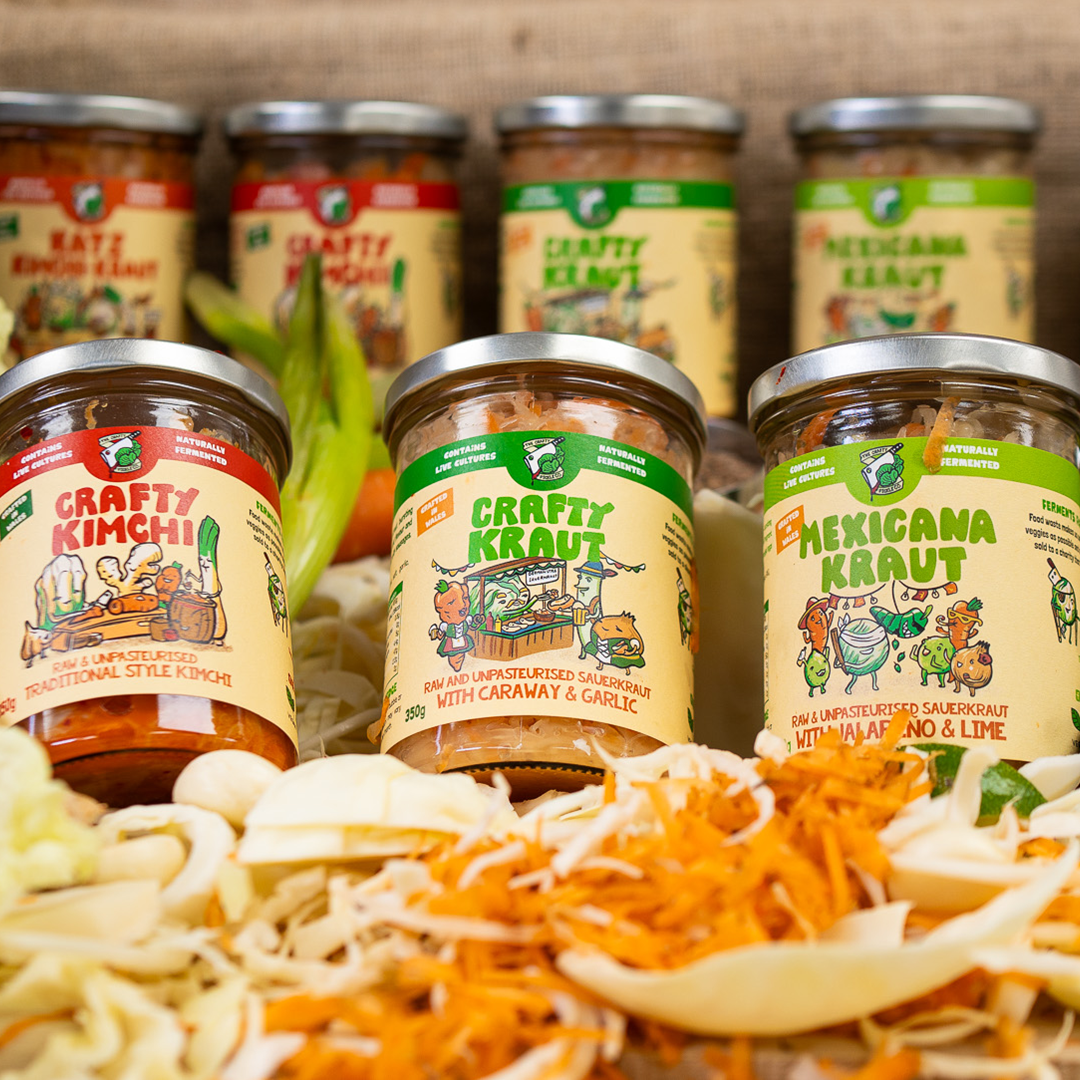
We get asked this a lot when we're out and about at markets. And while the internet would probably like us to pick a winner, we're going to disappoint you: There isn't a clear winner.
Kimchi and sauerkraut are both fermented vegetables and although they're made slightly differently, can contain different microbes and have slightly different nutritional profiles, we think the interesting question isn't really “which is healthier..?"
It's: “Which one do you enjoy eating?”. So let's look at why.
Sauerkraut vs kimchi at a glance
| 🥬 Sauerkraut | 🌶️ Kimchi | |
|---|---|---|
| Main ingredients | Usually cabbage + salt | Usually cabbage, radish, chilli, garlic, ginger & other ingredients |
| Fermentation | Lactic acid fermentation | Lactic acid fermentation |
| Live microbes? | Contains live microbes when unpasteurised | Contains live microbes when unpasteurised |
| Microbial diversity | Can contain diverse lactic acid bacteria communities | Often complex due to multiple ingredients & fermentation stages |
| Fermentation by-products | Organic acids and other fermentation metabolites | Organic acids and maybe a wider range of metabolites influenced by ingredients |
| Nutritional profile | Depends on recipe/product | Depends on recipe/product |
| Human health evidence | Limited | Somewhat more research, but still limited |
| Overall “winner”? | 🏆 | 🏆 |
| Our recommendation | Eat it if you love it | Eat it if you love it |
The short version: both can be excellent additions to a varied diet. But there isn't currently enough evidence to say that one is categorically “better for you”.
Is kimchi healthier than sauerkraut?
We don't have good evidence that it is. And this is where nutrition comparisons can get a little misleading. Kimchi often contains more ingredients than sauerkraut - garlic, ginger, chilli, spring onion, radish and sometimes other vegetables or umami ingredients like miso or fish sauce. That means it can provide a different combination of nutrients and plant compounds.
Kimchi fermentation can also produce a complex and changing microbial community, but so can sauerkraut fermentation. So none of this means we can conclude:
kimchi = healthier, sauerkraut = less healthy.
The human research simply isn't strong enough to support that hierarchy. And there's another problem with comparing them: there isn't one standard kimchi or one standard sauerkraut. Recipes vary. Ingredients vary. Fermentation conditions vary. So does the nutritional and microbial composition.
Which has more live microbes?
This is a question we hear a lot. The slightly frustrating answer is: It depends.
Both can contain live lactic acid bacteria (LAB) when they're fermented and stored appropriately without being heat-treated. But the presence of live bacteria doesn't automatically mean a food is a “probiotic”. Technically, a probiotic is a specific live microorganism that has been shown to provide a health benefit when consumed in an adequate amount. So are always cautious about calling all of the bacteria in kimchi or sauerkraut “probiotics”.
And we definitely wouldn't assume that kimchi automatically contains more beneficial bacteria than sauerkraut.
Does kimchi have more diverse bacteria?
It can. And this is one area where the science gets particularly interesting. Kimchi tends to contain a much wider range of ingredients than traditional sauerkraut. Those ingredients provide different environments and nutrients for microbes during fermentation.
Garlic is a good example. Research has found that changing the amount of garlic in kimchi can influence the bacterial community and microbial diversity during fermentation, as well as the metabolites produced. Both sauerkraut and kimchi also undergo microbial succession during fermentation, with different microbes becoming more or less abundant over time. So although some may argue that kimchi can have a more complex microbial community, we wouldn't turn that into the claim: “Kimchi always has more beneficial bacteria than sauerkraut.”
Because we don't have evidence for that.
The predictability of fermentation
This is perhaps the biggest reason we're wary of ranking fermented foods. The microbes in a ferment are influenced by:
- the ingredients
- where those ingredients came from
- salt concentration
- temperature
- fermentation time
- oxygen exposure
- starting microbial populations
- storage conditions
- whether a starter culture is used
- whether the food is pasteurised after fermentation.
Even apparently small changes can alter the microbial community and the compounds produced during fermentation. So if you ask: “Which has more bacteria - kimchi or sauerkraut?” The scientifically honest answer might be: “Which kimchi and which sauerkraut?”
Unless we test the actual products, we can't know their precise microbial profiles. The same applies to fermentation by-products or metabolites.
What about nutrition?
There are nutritional differences between kimchi and sauerkraut. But they're not necessarily meaningful enough to crown a winner. Traditional sauerkraut is primarily cabbage and salt. Kimchi typically contains cabbage plus a mixture of vegetables, aromatics and seasonings. So their nutrient profiles naturally differ slightly. Depending on the recipe, you might find differences in:
- fibre
- vitamin C
- vitamin K
- folate
- sodium
- other micronutrients and plant compounds.
But these differences need to be considered in the context of the whole diet, rather than treating one food as nutritionally superior. A serving of kimchi isn't competing against a serving of sauerkraut in a nutritional Olympics. They're foods. And food is about a whole lot more than a nutrient score.
What does the research say about health benefits?
This is where we'd really like to see more research. There is growing interest in fermented foods and their potential effects on the gut microbiome, immune system and metabolic health. But the human evidence is still relatively limited.
Kimchi has been studied more extensively than sauerkraut, particularly in intervention studies, but even here the evidence base is fairly small and the results aren't consistent enough to make sweeping claims.
A 2023 scoping review identified 11 randomised controlled trials involving 638 participants investigating kimchi and health outcomes, while also highlighting the limited number of adequately designed trials and conflicting findings. A 2024 review of fermented Brassica vegetables, including kimchi and sauerkraut, identified only a small number of clinical studies. That's not evidence that fermented vegetables don't have benefits. It's evidence that we don't yet know enough to make confident claims about exactly what they do, how much you need, or whether one type is better than another.
So which is better for your gut?
Again: we don't know that either is better. Both kimchi and sauerkraut can contain live microorganisms and fermentation-derived compounds. But the effects of fermented foods on the gut are likely to be more complicated than simply delivering bacteria to your large intestine. Some microbes may be transient rather than permanently colonising the gut. They may interact with the gastrointestinal environment as they pass through, interact with existing microbes or produce metabolites that affect the host.
And different fermented foods provide different microbial communities and fermentation by-products. Which brings us to something we think is much more interesting than choosing a winner.
Why not eat both?
If you enjoy sauerkraut and kimchi, there's no reason to choose. Eat both. And if you like other fermented foods, include those too. There's no end to the range of fermented foods you can include in your diet.
Kefir. Yoghurt. Miso. Tempeh. Sourdough. Cheese. Other fermented vegetables.
Different fermented foods can contain different microbes and fermentation by-products. We don't yet know exactly how much this diversity matters for human health, but it makes sense that a varied diet containing a variety of fermented foods is more interesting than obsessing over one “best” ferment. And there's another advantage. Variety makes food more enjoyable.
Which one should you actually eat?
Here's our favourite nutrition advice: the one you like. If you love sauerkraut, eat sauerkraut. If you love kimchi, eat kimchi. If you love both, alternate between them.
If you don't like either, you don't need to force yourself to eat fermented vegetables because someone on TikTok said they're essential for gut health. There's no prize for eating the “healthiest” food. And we're not interested in creating another food hierarchy where you're left worrying whether you've chosen the right cabbage.
Our verdict
Is sauerkraut or kimchi better for you?
There isn't a scientifically meaningful overall winner. Kimchi may have a more complex microbial community because of its wider range of ingredients and fermentation processes. Sauerkraut can have its own diverse microbial ecosystem and sometimes a much simpler ingredient profile. But the microbial composition and fermentation by-products can vary significantly between products and batches.
And while there are promising studies looking at fermented vegetables and health, we don't yet have enough clinical evidence to say that kimchi is healthier than sauerkraut - or vice versa. So rather than asking: “Which one is better for me?” We'd suggest asking: “Which one do I actually enjoy eating?”
Because enjoying your food matters. A food you love is more likely to become part of your diet than one you've been told you should eat. That's probably a much more useful approach than trying to crown a winner. No food hierarchy or superfood claims. Just good food and plenty of variety.
References
-
Zabat MA, Sano WH, Wurster JI, Cabral DJ, Belenky P. (2018). Microbial Community Analysis of Sauerkraut Fermentation Reveals a Stable and Rapidly Established Community. Foods, 7(5), 77.
Useful for the section on sauerkraut fermentation and how its microbial community develops and stabilises during fermentation. -
Leech J, Cabrera-Rubio R, Walsh AM, et al. (2020). Fermented-Food Metagenomics Reveals Substrate-Associated Differences in Taxonomy and Health-Associated and Antibiotic Resistance Determinants. mSystems, 5(6), e00522-20.
Particularly useful for supporting the point that the type of fermented food/substrate influences its microbial community — rather than assuming all fermented foods contain the same microbes. -
Jang HY, Kim MJ, Jeong JY, Hwang IM, Lee J-H. (2024). Exploring the influence of garlic on microbial diversity and metabolite dynamics during kimchi fermentation. Heliyon, 10(2), e24919.
This is the key paper behind the point that garlic can influence microbial diversity and metabolite production during kimchi fermentation. Importantly, it doesn't prove that all kimchi is more diverse than sauerkraut — it shows that changing garlic content can change the microbial community within kimchi. -
Song E, Ang L, Lee HW, et al. (2023). Effects of kimchi on human health: a scoping review of randomized controlled trials. Journal of Ethnic Foods, 10, 7.
This is useful for putting the human-health evidence into perspective: the review identified 11 RCTs involving 638 participants, but also highlighted limitations and conflicting findings. -
Fijan S, Fijan P, Wei L, Marco ML. (2024). Health Benefits of Kimchi, Sauerkraut, and Other Fermented Foods of the Genus Brassica. Applied Microbiology, 4(3), 1165–1176.
A useful overview of the clinical evidence specifically relating to fermented Brassica vegetables. The authors identified 12 clinical studies up to June 2024 and concluded that more clinical and mechanistic research is needed. -
Ahn S, Darooghegi Mofrad M, Nosal BM, Chun OK, Joung H. (2025). Effects of Fermented Kimchi Consumption on Anthropometric and Blood Cardiometabolic Indicators: A Systematic Review and Meta-Analysis of Intervention Studies and Prospective Cohort Studies. Nutrition Reviews, 83(7), e1441–e1457.
This is the more recent systematic review/meta-analysis and is worth including because it brings the evidence base up to 2024. It included five intervention studies involving 205 participants and four prospective cohort studies involving 42,455 participants.


