

- Gut friendly, Gut health, Gut Microbiota, Health, Kimchi, Living food, Nutrition, probiotic
- The Crafty Pickle Co.
Does eating kimchi remove microplastics from the body?
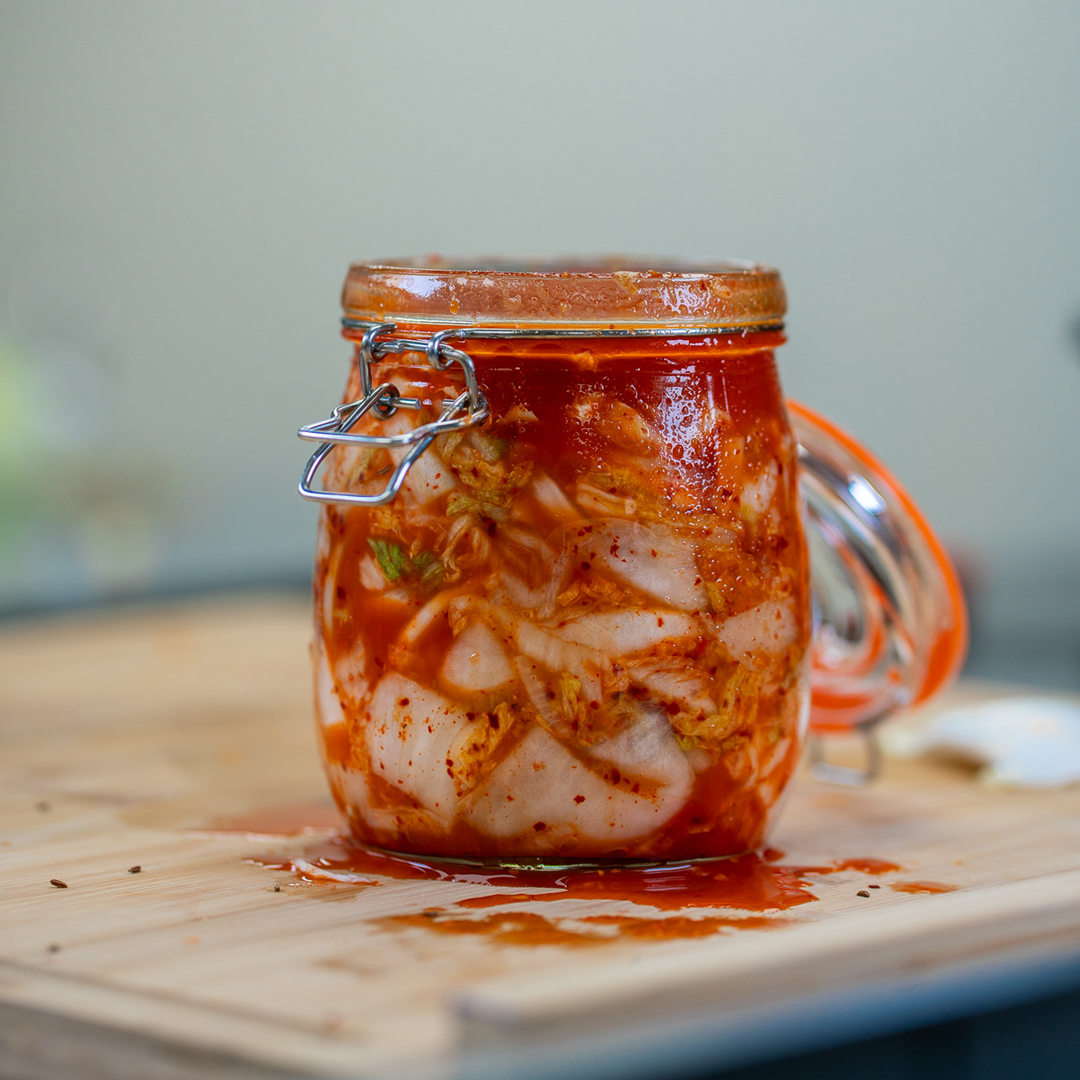
If you've spent any time on social media recently, you may have come across a rather exciting claim:
Eating kimchi can remove microplastics from your body.
As people who make kimchi, we'd obviously love this to be true. But we're also nutritionist-founded, which means we're generally more interested in what the research actually shows than what makes the best Instagram caption.
So, where has this claim come from? Is there any truth to it? And should we all be eating kimchi to flush plastic from our bodies? Let's take a look.
First: what are microplastics and nanoplastics?
Microplastics are tiny pieces of plastic, generally defined as particles smaller than 5mm. Nanoplastics are even smaller - typically particles below 1 micrometre in size.
They're increasingly being detected throughout our environment and in things we consume, including food and water. Researchers have also detected plastic particles in human biological samples.
It's understandably concerning.
There is laboratory and animal research suggesting that some micro- and nanoplastics can interact with cells, influence inflammation and oxidative stress, and affect the gut microbiome. But there's an important distinction here:
We know we're exposed to these particles but we don't yet fully understand what that exposure means for long-term human health.
That's a really important caveat. A lot of the research is still based on laboratory experiments or animals, often using concentrations and types of plastic that don't necessarily reflect the exposure experienced by an ordinary person. So we're dealing with a genuine area of scientific concern - but not yet a fully understood human health problem.
Where does kimchi come into this?
The recent excitement comes largely from a fascinating study published in 2026. And, at first glance, it sounds like exactly the sort of thing that would make you want to reach for the kimchi jar.
Researchers isolated a particular bacterium called Leuconostoc mesenteroides CBA3656 from kimchi and investigated whether it could interact with nanoplastic particles. They found that the bacteria could bind to the nanoplastics - a process known as biosorption. They then tested the bacterium in mice and found that giving the mice this particular bacterial strain increased the amount of experimentally administered nanoplastic recovered in their faeces.
Interesting? Absolutely.
Proof that eating kimchi removes microplastics from your body? No.
And that distinction is really important.
🧪 What the 2026 study actually found
The short version: Researchers isolated a specific bacterium from kimchi, showed that it could bind to nanoplastic particles in laboratory experiments, and found that giving the bacterium to germ-free mice increased faecal excretion of experimentally administered nanoplastics.
What it did NOT show: That eating kimchi removes microplastics or nanoplastics from humans.
There are several reasons why we shouldn't make that leap.
1. They studied a bacterium from kimchi - not kimchi
This is probably the most important detail to understand. The researchers didn't give people kimchi and measure their microplastic levels before and after. They isolated one particular bacterial strain from kimchi and studied that strain. And they didn't even study it in humans. So, that's quite different.
Kimchi is a complex fermented food containing a mixture of microbes, plant compounds, fibre, organic acids and other fermentation by-products. The microbial composition can also vary considerably depending on ingredients, fermentation conditions, the season, temperature and time.
So finding that Leuconostoc mesenteroides CBA3656 can bind nanoplastics doesn't mean that eating a serving of kimchi delivers enough of that particular bacterium to your digestive tract to produce the same effect. And it certainly doesn't mean that all kimchi behaves like a nanoplastic sponge.
It's an interesting mechanism, rather than a demonstrated health effect.
2. The experiment was done in mice, not humans
Animal studies are really useful. They allow researchers to test biological mechanisms in ways that would be difficult or impossible in humans. But they're still animal studies.
And this particular experiment used germ-free mice - animals raised without their normal community of gut microbes. That's useful scientifically because it gives researchers a very controlled environment. But it's also very different from you and me.
Our intestines contain a huge and highly competitive microbial ecosystem. When you eat fermented food, the microbes you're consuming don't arrive in an empty gut waiting to get to work. They encounter thousands of other microbial species, our digestive processes, mucus, immune cells and everything else going on in the gastrointestinal tract. So we can't assume that a bacterium behaving one way in a controlled, germ-free mouse will behave identically in a human.
3. More plastic in poo doesn't necessarily mean less plastic in your body
This is another subtle but important point. The researchers found that the mice given the bacterial strain excreted more of the experimentally administered nanoplastic in their faeces.
That's potentially useful. If a substance remains in the gut rather than being absorbed or interacting with tissues, increasing its excretion could plausibly reduce exposure. But to establish that this is actually beneficial to humans, we'd want to know much more. For example:
- Does it reduce the amount of nanoplastic reaching tissues?
- Does it reduce exposure of intestinal cells?
- Does it reduce inflammation?
- Does it change any meaningful health outcome?
- Does the effect occur at realistic human exposure levels?
- Does eating kimchi produce the same effect?
- And does the effect happen in humans?
The 2026 study doesn't answer those questions. Not even close. And that's not a criticism of the study. That's simply the job of early-stage research. A good scientific study doesn't have to answer every question. It can give us a new piece of the puzzle and tell us what to investigate next.
But haven't probiotics already been shown to interact with plastics?
Yes - and this is where the story gets genuinely interesting. There has been growing research into how probiotic bacteria and other microbes interact with microplastics, nanoplastics and chemicals associated with plastics.
Some laboratory research suggests that particular bacteria may have the potential to bind plastic particles or interact with compounds such as BPA and phthalates (Bazeli et al. 2023). Animal studies have also investigated whether probiotics can potentially reduce some of the biological effects associated with exposure to plastics. The key word here is potential.
There's a big difference between:
“This bacterium can bind to a plastic particle in a laboratory experiment.”
and:
“Eating a fermented food containing bacteria will remove plastic from your body and improve your health.”
There are several scientific steps between those two statements. And those steps still need testing.
So, should we be eating more kimchi?
We certainly wouldn't stop eating kimchi because we haven't proved it removes nanoplastics. But we also wouldn't eat kimchi because we think it does. There are plenty of other reasons to be interested in fermented foods.
Fermentation changes the food in interesting ways, producing organic acids, microbial metabolites and other compounds. Some fermented foods (like ours!) contain living microbes, and research is increasingly exploring how these microbes interact with our gut environment and immune system.
Importantly, those microbes don't necessarily need to permanently colonise your gut to have an effect. They may interact with the intestinal environment as they pass through, communicate with our existing microbiota or interact with intestinal and immune cells. There's some genuinely exciting science happening here.
But, just as with the microplastic research, we're careful about moving from plausible mechanism to proven health benefit.
The bigger lesson: beware the headline
This is a great example of how a scientific finding can change as it travels from a research paper to social media. The scientific finding is roughly:
A particular bacterium isolated from kimchi can bind nanoplastics in laboratory experiments, and giving that bacterium to germ-free mice increased faecal excretion of experimentally administered nanoplastics.
That's pretty cool. By the time it reaches social media though - in a process not dissimilar from Chinese Whispers - it has become:
“KIMCHI REMOVES MICROPLASTICS FROM YOUR BODY.”
Those statements aren't the same thing. And this isn't us being anti-kimchi. Not us, never! We think fermented foods are fascinating enough that they don't need exaggerated claims. There is plenty of genuinely interesting research to talk about without turning every promising laboratory finding into a superfood promise.
So, although we don't yet know whether eating kimchi or other fermented foods can reduce nanoplastics in the human body, this research gives us an interesting possible mechanism. For now, we'd put this one firmly in the “promising research: watch this space” category.
And if you already enjoy kimchi? Keep eating it because you like it, and because fermented foods are an exciting and nutritious part of a varied diet. Just don't feel that you need a forkful of kimchi to undo your exposure to plastic.
Science hasn't got us there yet.
And when it does, we'll be very interested to see the evidence.


